
UK Online Casino Rules & Licensing Framework 2026
 Available in GB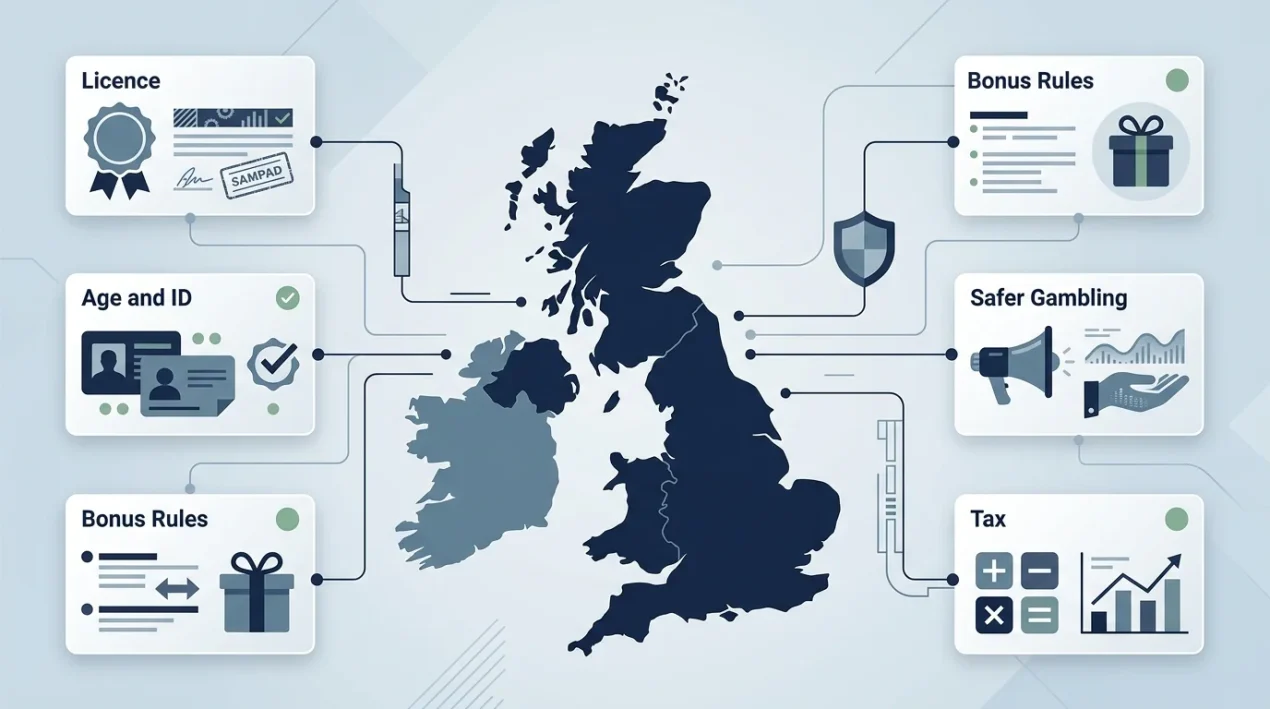
Contents
UK online casino rules form the backdrop to this Gentleman Jim review even though the brand itself closed on Wednesday 13 May 2026. The UK Gambling Commission regulates gambling operators serving Great Britain, the public register identifies which businesses hold which permissions, and a series of activity-specific rules govern age and identity verification, payments, bonus terms, slot stake limits, marketing and advertising. Lovell Brothers Limited, the licensee that operated Gentleman Jim, remains on the public register under account 60213 with its Casino Remote and Remote General Betting Standard rows shown as Active.
This page sets out the rules that matter when interpreting any closed-brand review or assessing an alternative UK casino. It points to dedicated cluster pages for the more detailed topics — bonuses, tax and safer gambling — rather than duplicating their content.
UK Online Casino Licensing & Regulations Overview
| Rule area | Current UK position | Why it matters in the Gentleman Jim context |
|---|---|---|
| Regulator | The Gambling Commission regulates gambling operators in Great Britain and maintains the public register. | Status checks should start with the register, not with old review pages or affiliate snippets. |
| Remote licensing | Remote operators serving British consumers need a Gambling Commission licence. | A replacement site not listed for the relevant remote activity is not a safe alternative. |
| Age and identity | Operators must verify a customer’s age and identity before allowing gambling. | No-KYC marketing conflicts with the licensed UK route by design. |
| Credit cards | UK-licensed online betting, casino and bingo operators must not accept credit-card gambling payments. | Sites promoting credit-card casino deposits are misaligned with UK rules regardless of brand. |
| Safer gambling | Licensed operators must make responsible-gambling information and self-exclusion routes readily available. | A visible safer-gambling area is part of the basic credibility check for any alternative. |
| Online slot stake limits | £2 per game cycle for customers under 25, £5 for customers aged 25 and over. | Historical slot content does not override current product rules. |
| Bonus wagering cap | From 19 January 2026 bonus wagering requirements are capped at 10×. | Pre-closure Gentleman Jim offers at 30× should be read as historical only. |
| Mixed-product promotions | Mixed-product incentives that move customers between betting and casino are restricted. | Cross-product bonus pages need closer reading after the rule change. |
| Financial vulnerability checks | Remote operators must run checks once net deposits cross £150 in a rolling 30-day period. | Payment friction here is a regulatory feature, not a customer-service failure. |
| Direct marketing | Remote gambling marketing preferences must be opt-in by product and channel. | Players should not face default casino-and-betting marketing without explicit consent. |
| Tax pointer | HMRC guidance treats ordinary gambling winnings from wagers and bets as outside miscellaneous income tax. | Tax discussion belongs as a pointer, not as personal financial advice. |
Top online casinos in the UK
- SlotoSportBonus: 500% up to £ 10 200+ 777 FS · Payout speed: 1-3 business days
- ZombillionBonus: Welcome Pack 250% up to £4000 + 200 FS · Payout speed: 1-3 business days
- NightLuckBonus: Welcome Pack + 805% Up To 6400€ + 280 FS · Payout speed: 1-3 business days
- x3betBonus: Welcome Pack 100% Up to £1.000 + 200 Free Spins · Payout speed: 1-3 business days
- AmunbetBonus: Join now and get 450% up to 2,700 GBP + 450 FS · Payout speed: 1-3 business days
- WinBeastBonus: €5000 + 500 FS + €650 Freebet · Payout speed: 1-3 business days
- SpinFormulaBonus: 550% Up To £15,000 + 550 FS · Payout speed: 1-3 business days
- BritsinoBonus: Welcome Package – Get your £2,200 + 2,000 FS · Payout speed: 1-3 business days
- DieselwinBonus: Welcome Pack 250% up to £4000 + 200 FS · Payout speed: 1-3 business days
- ChanzeBonus: Slots Welcome Bonus #1 200% up to €500 · Payout speed: 1-3 business days
The UKGC and the licensed UK market
The Gambling Commission is the statutory regulator for gambling in Great Britain, established under the Gambling Act 2005 and operating the public register of licensed businesses. Any operator that wants to offer remote gambling — online casino, online sportsbook, online bingo — to British consumers needs the relevant remote licence. The register is the controlling reference for current status, and it is publicly searchable by operator name or account number.
For Gentleman Jim the register entry sits under account 60213 in the Lovell Brothers Limited record. Casino Remote, General Betting Standard Real Event Remote and General Betting Standard Virtual Event Remote rows are all currently Active under reference 060213-R-337568-005, effective from 6 October 2023. The non-remote General Betting Limited row has been Active since June 2022. No regulatory actions are recorded against the account. The detailed walkthrough is on the UKGC public register checklist; the brand-specific reading is on the Lovell Brothers licence details page.
Age, identity and account verification
UK-licensed online gambling businesses must verify a customer’s age and identity before allowing any gambling activity. The UKGC’s age and identity verification guidance describes the kinds of documents operators can request — government photo ID, address evidence, occasionally additional documents — and confirms that operators must complete the checks before customers gamble, not after a withdrawal request. This is the rule that underpins KYC processes across the licensed market, and it explains why Gentleman Jim used KYC during operation.
For former customers reconciling pre-closure verification messages, the broader account-context page is registration and verification after closure. The same rule explains why “no-KYC” alternatives are not a UK-licensed route: there is no UKGC-permitted way to skip age and identity verification at a regulated operator.
Credit cards and other payment rules
UK-licensed online betting, casino and bingo operators are barred from accepting credit-card payments for gambling. The ban took effect on 14 April 2020 and applies across the regulated industry. It does not depend on brand, operator size or game type. Operators must also ensure that e-wallet gambling deposits are not funded indirectly from a credit card.
The practical reading for an alternatives search is straightforward: any site offering credit-card casino deposits to UK customers is either unlicensed or in breach of the rule. The same rule explains why pre-closure Gentleman Jim payment pages emphasised debit cards, Apple Pay, Maestro and bank transfer rather than credit cards. Withdrawal-side context for former Gentleman Jim customers sits on the pending-payment checks page.
Slots stake limits and the January 2026 bonus rule changes
Online slots in Great Britain are subject to maximum stake limits per spin: £2 for customers under 25 and £5 for customers aged 25 and over. The limit was phased in during 2024 and applies to online slots specifically, not to live casino, bingo or table games. Historical slot content from the Gentleman Jim lobby — including the Big Bass Splash welcome-offer titles — has always been subject to these limits during operation.
Bonus rules changed on 19 January 2026. The Commission capped bonus wagering requirements at ten times across UK-licensed operators and restricted incentives that require play across more than one gambling product. Mixed-product promotions that move customers between sports betting and slots, or between casino and bingo, are now narrower in scope than they were when Gentleman Jim launched its 30× wagering welcome offer. The detailed page is UK bonus rules, and there is no current claimable Gentleman Jim welcome promotion in any case.
Financial vulnerability checks and marketing preferences
Remote operators must run financial vulnerability checks when a customer’s net deposits exceed £150 in a rolling thirty-day period. The check uses public-record vulnerability indicators and requires proportionate action when risk is identified — typically a documentation request or a deposit-pace conversation. Payment delays at this threshold are part of the consumer-protection framework, not a discretionary operator behaviour.
Direct-marketing rules are more specific than a single unsubscribe option. Remote gambling marketing preferences must be opt-in by product (sports betting, casino, bingo, lottery) and by channel (email, SMS, phone). Operators cannot bundle all categories under one default consent. For UK readers assessing an alternative, a well-structured marketing-preferences page is a meaningful credibility signal.
Advertising standards and protected groups
Gambling advertising aimed at British consumers must follow UKGC licensing requirements together with the ASA and CAP advertising rules. The framework focuses on social responsibility, protection of under-18s, protection of vulnerable customers and a ban on messages that present gambling as a solution to financial problems. Affiliate sites and direct operator advertising are both within scope.
This is directly relevant to closed-brand search results. A current page using urgency, no-verification access, GAMSTOP-avoidance positioning or exaggerated bonus value as a Gentleman Jim alternative is not only thin content — it is misaligned with the UK advertising compliance framework. The structured comparison framework is on the safe alternatives framework page.
Tax position for ordinary UK players
HMRC guidance treats gambling winnings from wagers and bets as outside miscellaneous income tax for ordinary players. The position rests on the Business Income Manual and a long-standing principle that gambling winnings are not earned income in the ordinary sense. HMRC also notes that being systematic or successful at betting does not by itself create a trade. The detailed page is UK gambling winnings tax, which keeps the personal-advice boundary clear.
This pointer is enough to stop the two most common reading mistakes: treating every gambling win as taxable miscellaneous income, or treating a brief editorial note as advice for a personal tax return. Unusual arrangements — paid betting services, professional gambling, cross-border tax residence — can change the analysis, and they fall outside what an editorial review can address.
The statutory gambling levy
The statutory gambling levy commenced on 6 April 2025 and applies to licensed gambling activity at sector-specific rates. It is primarily an operator-facing obligation that funds research, prevention and treatment of gambling-related harm through approved bodies. For UK consumers the levy is part of the regulatory background rather than a comparison signal between operators — paying it is a baseline expectation of holding a UKGC licence, not a differentiator. Safer-gambling support routes that the levy helps fund are linked from the GAMSTOP and safer gambling page.
Sources checked for this page
- UKGC licence summary for Lovell Brothers Limited account 60213
- UKGC remote gambling sector guidance
- UKGC age and ID verification guide
- UKGC credit-card gambling guidance
- UKGC online slots stake-limit guidance
- UKGC announcement on 2026 bonus rule changes
- UKGC LCCP 3.4.4 financial vulnerability check
- UKGC LCCP 5.1.12 direct marketing preferences
- HMRC BIM100101 on miscellaneous income and gambling winnings
- UKGC statutory gambling levy guidance
This material was created by the Gentleman Jim UK Guide team.
Related posts

Terms of Use

UK Casino Sites and Slots: Fairness and Rules