
Live Blackjack Online at UK Casinos: How It Works
 Available in GB
Contents
A practical guide to the video-and-interface setup, table choices, hand decisions and rules of live blackjack in UK casinos.
What a Live Blackjack Session Actually Looks Like
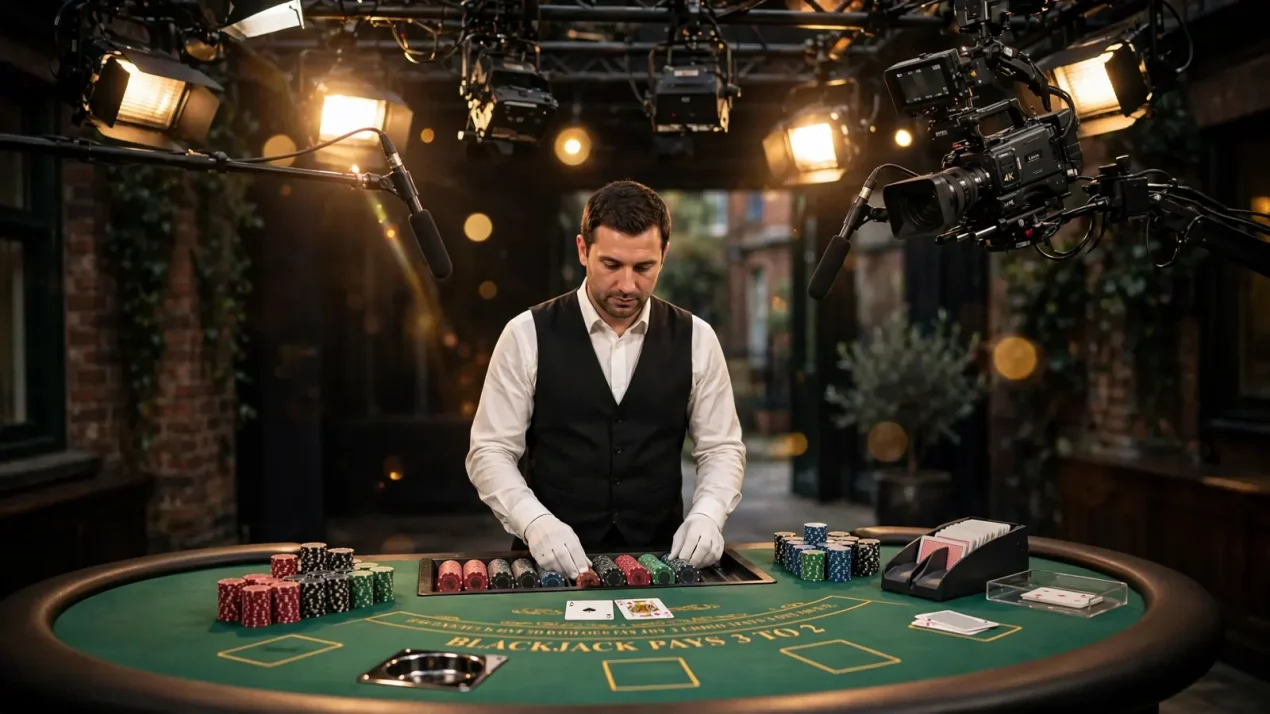
A live blackjack session feels different from a computer-generated game because the table is shown as a video stream. You see a real dealer working at a physical table, while your view of the game is paired with controls on the casino screen. The dealer handles the cards; you use the interface to take part.
On a phone, the stream and the controls share a small display. On a larger screen, it is easier to keep both in view, but the basic arrangement is the same: watch the table, check what the interface is showing, and make your choice there when prompted. You are not speaking to the dealer or handling cards yourself. Your input goes through the casino software.
That split is worth noticing before you join. The video gives you the human, table-side view; the interface tells you when you can act and records your selection. If you look only at the stream, it is easy to miss a prompt. If you focus only on the buttons, you lose the sense of what is happening at the table. I find it helps to keep an eye on both rather than treating live play as a film with occasional clicks.
There is a shared rhythm, too. A hand has to move along for everyone at the table, so you may have a short window to respond when the game asks for a decision. The pace can feel less solitary than a standard online casino game, even though you are still playing through your own account and screen. If the stream pauses or the picture falls behind, the interface remains the place to check what the game is asking of you.
The format is not complicated once you separate the two parts: a dealer and a streamed table on one side, your controls on the other. That is the basic shape of live blackjack online in the UK in 2026. It is still gambling, not a social video chat, and the polished studio setting does not change the risk. Only gamble what you can afford to lose.
Live Baccarat Online Casinos in the UK: Licence Checks
Choosing a UK Casino for Live Blackjack
Before I look at a casino’s live blackjack offer, I check who is legally responsible for taking my wagers. For a player in Great Britain, the practical first step is the UK Gambling Commission’s public register. Remote operators serving customers here must hold the relevant Commission licence, even if their equipment or company offices are based elsewhere.
Search the register for the operator’s name and check that the entry matches the casino you intend to use. Compare the stated website domain too: a similar brand name is not enough if the domain does not line up. The Commission regulates commercial gambling in Great Britain and is the country’s sole regulator for that activity. It issues operating licences to businesses and personal licences to individuals working in the industry; for choosing a casino, the business’s operating status is the point to verify.
Do this before depositing, not after a payment or withdrawal problem. A licence badge on a casino’s own page can be a useful pointer, but it is not a substitute for checking the public register. If you cannot confidently match the operator and its site, pause. That is a better moment to be cautious than when money is already in the account.
Check how the account is protected
A suitable operator should make its safeguards visible before you need them. In Britain, it must verify your age before allowing you to deposit. A new customer should also be prompted to set a financial limit before making a first deposit, with account-level controls available afterwards. Look for these controls in the account area and check that you can find them without digging through unrelated menus.
I would also make sure the site explains how to take a break or exclude yourself from gambling. UK-licensed casinos must provide responsible gambling tools, including self-exclusion. GAMSTOP is a separate national self-exclusion service; if you choose to use it, check its own information so you understand what it covers. A tool is useful only if you can locate it and understand what happens when you switch it on.
Do
- Check the UK Gambling Commission’s public register
- Set a financial limit before your first deposit
- Use national self-exclusion services like GAMSTOP
Don’t
- Rely solely on a licence badge on the casino’s page
- Deposit money before verifying the operator’s licence
- Assume safeguards are straightforward without checking the account area
A casino’s tone around these features tells you something. If the controls are hard to find, or the site makes it awkward to set a limit or close an account, treat that as a reason to slow down. I’d rather spend a few minutes checking the account area than assume everything will be straightforward once play starts.
Read the complaints route before trouble starts
Find the operator’s complaints procedure and note how it says to raise an issue. UK-licensed operators must offer an internal complaints process and access to an approved Alternative Dispute Resolution service. The site should explain how to contact its complaints team and what route is available if you cannot resolve the matter directly.
Keep copies of relevant messages and account records if you do have a dispute. Be clear about the issue and what response you are seeking. If the operator’s process is vague, or you cannot find any information about independent dispute resolution, that is worth weighing before you sign up. A polished homepage is no answer to a missing complaints route.
The Commission’s remit also matters if an operator says its servers or key equipment are located abroad. Remote gambling offered to consumers in Great Britain remains subject to the Commission’s rules regardless of where that equipment is. An overseas address does not, by itself, remove the requirement for the relevant British licence.
Online Keno Casinos in the UK: What to Check
Check the funding and limit controls
UK-licensed casinos cannot accept credit cards for gambling, including credit-card funding routed through a money service business. They also cannot accept wallet payments when the wallet allows credit-card funds to be used for gambling. If a payment option appears to work around that restriction, do not treat it as a clever workaround; check the operator’s explanation and, if needed, its licence status.
Before you deposit, confirm that the available payment method is one you understand and that the account shows your balance and activity clearly. The key check here is not whether a casino advertises a long list of methods, but whether its rules and controls are transparent. You should be able to manage limits through your account rather than rely on a support conversation after spending has begun.
Licensed operators are also required to contribute to the Research, Education and Treatment levy. That obligation is part of the wider regulatory framework, rather than a personal safeguard you need to calculate or arrange yourself. Your own practical checks remain the register, account controls, self-exclusion information and complaints route.
I do not treat a familiar name, a slick site or a live blackjack label as proof that an operator is suitable. Check the licence entry against the actual domain, inspect the safeguards, and make sure you understand how to raise a complaint. If anything does not add up, leave the account unopened. And only gamble what you can afford to lose.
Verifying a UK Casino
- Match the operator’s name and domain on the UK Gambling Commission register
- Locate the account-level financial limit controls
- Verify that age verification is required before depositing
- Find the internal complaints procedure and ADR service details
- Confirm the site’s self-exclusion and break-taking options
Top online casinos in the UK
- SlotoSportBonus: 500% up to £ 10 200+ 777 FS · Payout speed: 1-3 business days
- ZombillionBonus: Welcome Pack 250% up to £4000 + 200 FS · Payout speed: 1-3 business days
- NightLuckBonus: Welcome Pack + 805% Up To 6400€ + 280 FS · Payout speed: 1-3 business days
- x3betBonus: Welcome Pack 100% Up to £1.000 + 200 Free Spins · Payout speed: 1-3 business days
- AmunbetBonus: Join now and get 450% up to 2,700 GBP + 450 FS · Payout speed: 1-3 business days
- WinBeastBonus: €5000 + 500 FS + €650 Freebet · Payout speed: 1-3 business days
- SpinFormulaBonus: 550% Up To £15,000 + 550 FS · Payout speed: 1-3 business days
- BritsinoBonus: Welcome Package – Get your £2,200 + 2,000 FS · Payout speed: 1-3 business days
- DieselwinBonus: Welcome Pack 250% up to £4000 + 200 FS · Payout speed: 1-3 business days
- ChanzeBonus: Slots Welcome Bonus #1 200% up to €500 · Payout speed: 1-3 business days
Live Dealers, Providers and the Tables You’ll Find
A live blackjack table is shaped by more than the casino that displays it. The game provider supplies the live product, while the operator makes it available through its own site or app. That distinction matters when you are browsing: two casinos can offer live blackjack yet present different providers, table layouts and surrounding games. The dealer is part of the format, but the provider helps define what the table feels like to use.
You may see names such as Evolution or Playtech in a live casino lobby. Treat those as provider names, not as a guarantee that every table will look or work the same way. A provider can offer a range of live games, and the operator decides which products appear in its lobby. The exact selection can therefore vary between casinos and change over time. I find it more useful to look at the table itself than to assume a familiar provider name tells you everything.
The dealer-led range often reaches beyond blackjack. Roulette and poker games are familiar fixtures in live casino menus, alongside other card and casino games. Grosvenor gives a concrete UK example: it first introduced its live casino games in 2013, with Blackjack, Texas Hold’em and Roulette among the games offered. That history shows how a live casino can bring several kinds of table play together, rather than being a single blackjack product.
For someone looking specifically for a live dealer blackjack casino in the UK, the provider is one part of the experience, not the whole story. A streamed dealer-led game differs from an automated digital table, but the provider’s presentation, the operator’s interface and the available table formats all affect what you encounter. You do not need to know the production setup to make sense of the lobby; noticing who supplies the game and how it is labelled is enough to orient yourself.
Fast payout online casinos in the UK, explained
Providers can also supply games that borrow the atmosphere of a studio or a casino floor without being blackjack. Names such as Crazy Time, Dream Catcher and Lightning Roulette may appear among live offerings. They are separate products, not alternate names for blackjack. Their presence can make a live casino feel broad, but it does not tell you whether the blackjack tables suit your preferences. Keep the categories straight.
There is a practical reason to notice the provider before opening a table: if you are comparing live blackjack across operators, you may be looking at different products even when the game name is the same. A consistent title does not mean an identical presentation. Check the information attached to the table, including its provider label, rather than relying on a casino’s general “live” badge. Small detail. Useful one.
The same caution applies when you see private or branded table labels in a lobby. A name can describe a particular table offering, but it is not itself proof of how the game is run or what rules apply. Providers and operators divide the work: one supplies the game, the other chooses how to offer it to customers. That is the useful map to keep in mind when you browse a live dealer blackjack online casino: provider, operator, then individual table.
Blackjack Tables and Casino Game Variants
A casino lobby can make a long list of blackjack tables look like a long list of different games. Often, the first useful distinction is simpler: is the title a blackjack table, another live card game, or a different kind of casino game altogether? I check the game name and its short description before treating two listings as separate choices.
Blackjack tables may be grouped by format or presented under a named variant. Infinite Blackjack, for instance, is a title you might encounter in a live casino menu. The name alone does not tell you everything that matters about the version, so open its information panel and read what the casino says about the game. Look for clear descriptions rather than assuming that tables with similar artwork or familiar names work in exactly the same way.
Fastest Payouts at UK Online Casinos: What to Check
A casino may also show several blackjack listings that appear nearly identical. They could be separate tables, presentations or versions, but the lobby label is only a starting point. Compare the displayed game information, table name and any stated features side by side. If the description is too vague to tell one listing from another, there is little value in guessing. Pick a clearly labelled option or leave that listing alone.
It helps to keep blackjack separate from the other live games around it. Roulette is not a blackjack variant, even when both appear in the same live-casino category. Lightning Roulette is a roulette title; Crazy Time and Dream Catcher are also distinct game names, not alternate blackjack tables. A lobby may place all of these under a broad live-games heading, but that grouping describes the section of the site, not the game you are selecting.
The same care applies to card games. A title may involve cards without being blackjack. Check the category and description rather than relying on a card image or a dealer-themed banner. That small pause saves you from opening a game expecting one thing and finding another.
When I compare casino blackjack games, I keep the menu check practical: identify which listings are actually blackjack, note any named variants, then read the description for each one I might try. Don’t infer rules from the title or assume that every table uses the same version; the table information is where to check those details before playing. No need to make the lobby a puzzle. My aim is simply to know what game I’m opening.
Choose a table that is clearly identified and suits what you want from the game, rather than selecting by thumbnail alone. And keep the wager within money you can afford to lose.
How to Play a Hand Without Losing the Thread
Before joining a live blackjack table, check the on-screen wager controls and make sure you understand how to confirm your stake. The layout varies between casinos, but the sequence is straightforward: place your wager during the betting window, wait for the deal, then choose an action when the interface prompts you. If you are trying a free-play version, the same steps may be simulated, though its availability depends on the casino.
Playing a Hand
Place your wager
Select your stake using the on-screen controls during the betting window.
Observe the deal
Wait for the dealer to distribute the cards to the players and themselves.
Select your action
Use the interface buttons to choose whether to hit or stand when prompted.
Await the result
Wait for the dealer to finish the hand and for the interface to update your balance.
Once betting closes, the dealer gives the players their cards and takes the dealer’s own cards. Your hand appears in the interface, usually with buttons for the actions available at that moment. Don’t rush to click as soon as cards land. Take a moment to check which hand is yours and what the screen is asking you to do.
The first decision is whether to take another card or stand with what you have. The labels may read “Hit” and “Stand”, or use plainer wording. Choose a card if you want to continue building your hand; stand if you want to stop. The table may offer other actions too, depending on its rules and the situation. If you don’t recognise a button, pause and look for the table’s help or rules panel rather than guessing.
After you act, the game moves on to the next player or back to the dealer. Keep an eye on the prompt: a decision may only be available while your hand is active. When the dealer finishes, the table marks the result and updates your balance. Then the round ends, and you can decide whether to join the next one.
A common first-session slip is confusing the controls with the game itself. The interface handles the card dealing and records your choices; you are responsible for selecting an action when prompted. If a hand moves on before you have followed what happened, use the table history or help panel if one is available. There’s no need to chase the pace.
Jackpot mobile casinos in the UK: how to compare
I’d keep the first visit simple: watch a hand or two, read the prompts, then join only when you’re comfortable with the layout. Set a limit you can stick to, and gamble only what you can afford to lose.
How Blackjack Works—and What Winning Depends On
Blackjack is a contest between your hand and the dealer’s. The aim is to finish with a hand closer to twenty-one than the dealer’s, without going over. You are not trying to beat the other people at the table; their hands do not decide whether yours wins.
Number cards count at face value, picture cards count as ten, and an ace can count as either one or eleven. That flexible value makes the ace useful, but it does not guarantee a strong hand: its value depends on the other cards you hold. A hand with an ace counted as eleven is often called soft, because the ace can instead count as one if taking another card would otherwise send the total over twenty-one.
The dealer’s hand matters because your total is judged against it. If your hand goes over twenty-one, you bust and lose, even if the dealer later busts too. If you stay within the limit, you can win by finishing closer to twenty-one than the dealer, or by the dealer going over while you remain in. If both totals match, the result is generally a stand-off, often called a push, rather than a win for either side. The table’s rules determine the precise settlement, so the label and payout shown there are worth checking.
Soft Hand
A hand containing an ace that can be counted as either one or eleven, meaning the player cannot bust by taking one additional card.
A natural blackjack is a special opening hand: an ace with a card worth ten. It is not simply any hand that reaches twenty-one after taking more cards. How a natural is settled can depend on the table’s rules, including whether the dealer also has one. That distinction is easy to miss when you are new, and it can affect the result even though both hands total twenty-one.
So, how does casino blackjack work in practice? The hand’s outcome follows from the cards dealt, the choices made during play, and the dealer’s hand under the table rules. Your decisions can affect how your hand develops, but they cannot control which cards appear. A choice that looks sensible can still end in a loss; a risky choice can sometimes work out. The result of one hand is not proof that a decision was sound or unsound.
That is why “how to win” needs a realistic answer. You can learn what each hand means and make decisions with the rules in mind, but there is no guaranteed way to win online or at a physical casino. The dealer’s advantage, where the rules create one, is not erased by a streak of wins or by feeling that a particular card is due. Each hand can turn on its own cards. No system changes that.
The useful measure is not whether every hand pays out. It is whether you understand what determines the result and can accept that losses are part of gambling. I’d treat a win as an outcome, not a promise of another one. Keep your expectations modest, and only gamble what you can afford to lose.
A Practical Blackjack Strategy for Live Tables
A useful blackjack strategy is less about finding a clever trick than making decisions in a steady way. Live tables can add pressure: the dealer is on screen, other players are present, and the game keeps moving. I find it helps to decide how I’ll approach a session before joining, rather than changing tack after a win or a frustrating hand.
Online Casino Payouts in the UK: Understanding RTP
Use a recognised basic-strategy reference for the rules of the particular game, and keep it available if the table permits. The right decision can depend on the cards you hold and the dealer’s visible card, as well as the table rules. Don’t rely on a vague memory of what worked last time. A reference can help you follow a consistent approach, but it cannot tell you what will happen next or make a hand certain to win.
Keep the session plan simple. Decide in advance what you can afford to lose, and stop when you reach that point. A win is not a reason to raise your stakes automatically, and a loss is not a cue to chase it with larger wagers. If you feel rushed, annoyed or distracted, step away. The stream will still be there later.
It is easy to mistake a run of results for a signal that the next hand is due to go your way. It isn’t. Treat each decision on its own merits, and don’t let the table’s pace or another player’s choice push you into an action you haven’t considered. If you are unsure, taking a pause is better than clicking just to keep up.
A sensible live blackjack strategy also includes using the casino’s account controls. Set a financial limit and use it to support the boundary you chose for yourself; don’t treat a limit as a target to reach. If gambling stops feeling like entertainment, stop and seek support.
There is no strategy that removes the game’s risk. The aim is to make considered choices and keep the session within bounds, not to turn blackjack into dependable income. Only gamble what you can afford to lose.
How to Compare Casinos Without a ‘Best’ List
A “best” label is not much use if it hides what you actually need from a live blackjack site. One player wants a table available when they log in; another cares more about a clear interface and easy-to-find account controls. I’d compare those things separately rather than treating a ranking as a verdict.
French Roulette Online Casinos in the UK
Once you have checked that an operator is properly licensed, look at the experience you will actually get. A casino can have a broad live lobby but still be awkward for the way you play. Another may have fewer choices, yet make it easier to find a suitable table and keep track of a session. Neither is automatically the best blackjack casino for every UK player.
Start with access, not the lobby’s size
Check whether live blackjack is available at the times you are likely to play. A table listed in a lobby is not necessarily open whenever you visit, and the display may change as tables become available or close. Look for clear information about whether a game is live, what table choices are currently offered and whether the lobby lets you filter or search without fuss.
Then see how quickly you can get from the casino home page to the blackjack section. If the live games are buried beneath promotions or unrelated content, that friction matters. You should be able to return to the lobby and understand where you are without repeatedly opening new pages or losing sight of your account.
Don’t count every tile as a meaningful choice. A long list can include tables that feel much the same from a player’s point of view. What matters is whether you can identify a table that suits your preferences and understand its displayed information before joining. The table menu itself deserves a closer look; a casino’s overall game count tells you little about whether its blackjack offering works for you.
Judge the interface during a real visit
Take a few minutes to look around before wagering. Can you read the table information on your device? Are the controls clearly labelled? Is it obvious how to leave a table and return to the lobby? A polished landing page is not the same thing as a usable live game.
A polished landing page is not the same as a usable live game; it is important to test the interface on your actual device to ensure menus are legible and account links are accessible.
I pay attention to small points that become irritating when repeated: a lobby that resets your filters, unclear loading messages, or account links that are difficult to locate. A live stream can be perfectly watchable while the surrounding interface makes simple tasks feel like detective work. If you cannot tell what a button does, do not press it just to find out.
Try the site on the device you expect to use. A layout that works well on a large screen may feel cramped on a phone, particularly when table details and controls compete for space. You do not need to make a wager to assess whether the menus are legible and the path back to your account is clear.
Treat account controls as part of the comparison
Convenience is not the only measure. Before depositing, check how the operator handles account limits and safer-gambling tools. Remote operators must prompt new customers to set a financial limit before their first deposit and provide accessible controls for managing account limits. Those controls should be straightforward to find later, not hidden in a corner you are unlikely to revisit.
Age verification is also part of the process: operators must verify a customer’s age before allowing them to deposit. UK-licensed casinos must provide responsible-gambling tools, including self-exclusion. Compare how clearly these options are presented and whether the account area makes them easy to locate. A safeguard is useful only if you can find and understand it.
Look at the route for raising a complaint as well. UK Gambling Commission licensees must offer an internal complaints process and access to an approved Alternative Dispute Resolution service. You are not assessing how likely a dispute is; you are checking whether the steps are visible and explained in plain language. That is a sensible part of choosing an online blackjack casino, not an afterthought.
Make a short, personal scorecard
Instead of asking which site is the best online casino for blackjack, write down the features that would make a difference to you. Keep the comparison practical:
- Can you find live blackjack and see which tables are available?
- Is the lobby readable and easy to navigate on your device?
- Are account limits, self-exclusion and help information easy to reach?
- Can you find the operator’s complaint process and its ADR details?
- Does the site explain its account and table information clearly?
Use the same questions for each casino you are considering. That stops a flashy lobby from getting more credit than it deserves and makes differences easier to remember. If one site is simpler to use but another presents its safeguards more clearly, you can decide which matters more to you.
There is no universal best blackjack casino in the UK, because the useful comparison depends on your habits and priorities. A table that is easy to find may matter more to you than a large lobby; clear account controls may matter more than either. Choose on the details you can actually verify, and gamble only what you can afford to lose.
Bonuses, Bitcoin and the Small Print
A blackjack promotion can look generous in the banner and much less useful in its terms. Before accepting a bonus, I check whether live blackjack is eligible at all. Some offers exclude particular games or count blackjack wagers differently from other casino play, so the headline alone tells you little.
Attention Blackjack promotions often exclude live tables or count wagers differently than other games, so always check the written terms before accepting a bonus.
Read the conditions for the qualifying deposit, any wagering requirement, the time allowed to meet it, and what happens if you withdraw early. Check whether the offer applies to live tables, whether a maximum wager applies while it is active, and whether winnings are subject to extra restrictions. The detail matters more than the label: “no deposit” does not mean unrestricted or automatically available, and a blackjack-specific offer is still governed by its written terms.
Payment claims need the same careful reading. A site mentioning Bitcoin does not prove that the option is available to you, works for every account, or can be used for withdrawals. Check the casino’s own cashier and payment terms before relying on any advertised method. Treat claims about speed, fees or anonymity cautiously unless the operator sets out what applies to your transaction.
For UK-licensed gambling, credit cards cannot be used to fund gambling. That also rules out credit-card funds routed through a money service business, and a digital wallet cannot be used for gambling if it lets you spend credit-card funds. Don’t assume that changing the payment route changes the restriction.
Operators must check your age before letting you deposit, and new customers must be prompted to set a financial limit before their first deposit. Take a moment to set one you can live with; account controls should remain accessible afterwards. A bonus is not a reason to raise it. I’d rather leave an offer untouched than let its conditions steer my spending.
Whatever the payment method or promotion, only gamble what you can afford to lose.
Live Roulette in the UK: Dealer Tables Explained
Blackjack Rules at the Table—and the UK Slot-Limit Difference
Before joining a live table, open its rules panel. Blackjack rules can vary between games, even when the layout looks familiar. Check how the table handles a soft seventeen, whether doubling is allowed on any starting hand, and which hands can be split. These details affect the choices available to you, so don’t assume one table follows the same settings as another.
Look at the payout for a natural blackjack, too, and read the conditions attached to insurance, surrender or side bets if they are offered. A side bet is separate from your main wager; it can have its own terms and should not be treated as part of the basic game. If a rule is unclear, take a moment to find the table information before you play. Small print matters here.
One point is easy to muddle in the UK: online slot stake limits are not blackjack limits. A specialist review describes Great Britain’s slot cap as £5 per game cycle for adults aged twenty-five or over, and £2 for adults aged eighteen to twenty-four. The same type of review distinguishes roulette and blackjack from slots, stating that those slot limits do not apply to either table game. So don’t use a slot limit as a guide to the stake permitted at a blackjack table; check the table’s own displayed limits and terms.
That distinction doesn’t make blackjack risk-free or remove the need to set your own boundaries. Decide what you can afford to lose before you sit down, and stop when you reach that amount. I’d rather leave a table with a clear head than chase a hand because the rules seemed familiar.
Are online casino games licensed and regulated?
Yes. Online casinos serving customers in Great Britain must hold the relevant UK Gambling Commission licence, and the Commission regulates their gambling activity.
What are the online slot stake limits in Great Britain?
The limit is £5 per game cycle for adults aged 25 and over, and £2 for adults aged 18 to 24. These limits apply to slots, not blackjack or roulette.
Is LuckyPays licensed by the UK Gambling Commission?
No entry for LuckyPays or its stated domain, luckypays.io, appears on the public Gambling Commission register. Check the register and match the operator and website domain before depositing.
What are the differences between UK-licensed and non-UK-regulated online casinos?
A casino serving customers in Great Britain must hold the relevant UK Gambling Commission licence, regardless of where its equipment is located. Regulation by another country alone does not meet that requirement.
Related posts

Terms of Use

UK Casino Sites and Slots: Fairness and Rules