UK Online Casino Game Shows: How They Work
 Available in GB
Contents
These games combine a live studio broadcast with digital player controls, using formats that can centre on wheels, boards or graphics.
How Online Casino Game Shows Work in a Live Casino
A live casino game show sits between a streamed casino table and a television-style entertainment programme. You watch a presenter in a studio, see the game unfold on screen and use a separate on-screen interface to take part. The result is a format built to be watched as well as played: the host supplies the human presence, while the digital game system handles the player’s interaction.
That combination explains why these games feel different from a conventional online slot or a standard live-dealer table. A slot generally puts the reels and controls centre stage. A live-dealer table focuses on a dealer and the process of a familiar casino game. A game show makes the studio presentation part of the experience. You are following an unfolding broadcast, not simply pressing a spin button or watching cards dealt.
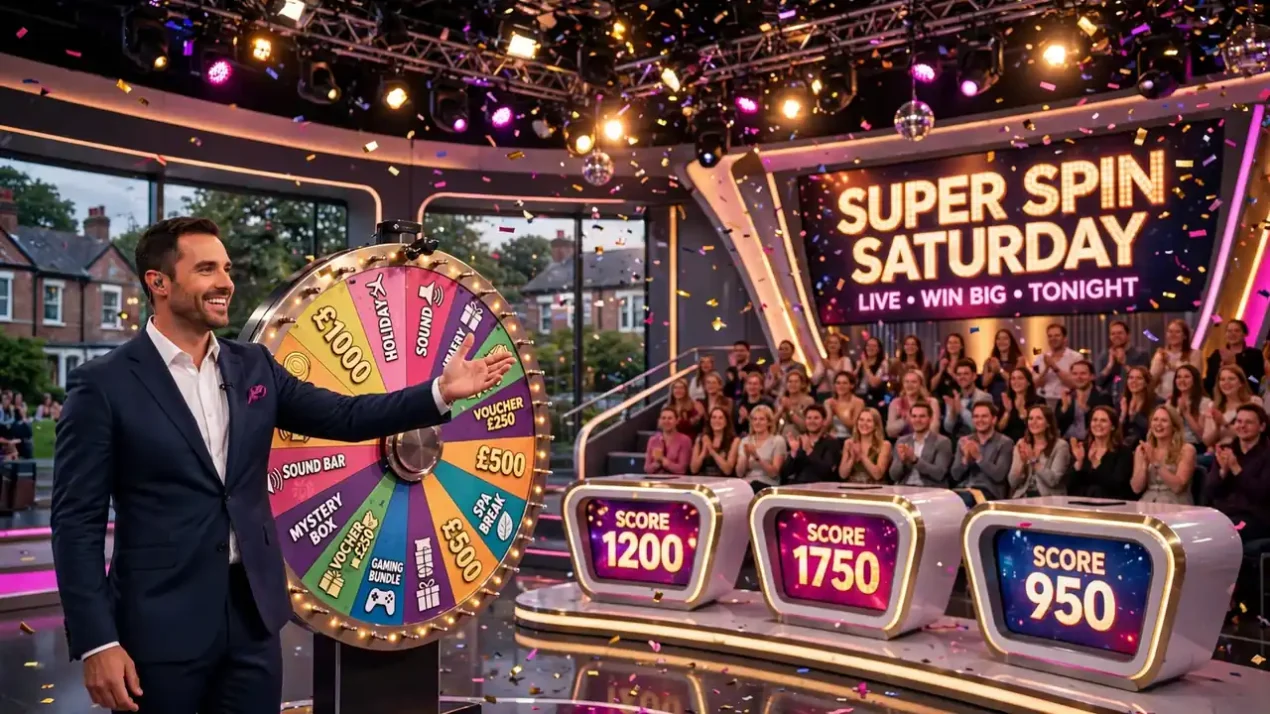
The category is broad, and there is no single template that every title follows. Some games may use a central wheel, board or other visible device; others may rely more heavily on graphics and a host’s presentation. The common idea is the mixture of live studio entertainment and casino-style play. “Game show” describes that style, rather than guaranteeing a particular set of rules, pace or level of interaction.
The screen has two jobs
When you join an online casino live game show, the screen usually has to do two things at once: carry the studio programme and provide the tools for play. The video shows the presenter and the action in the studio. The interface gives you a way to make your selections and see information relevant to your participation. Those elements may appear together, but they serve different purposes.
It helps to keep that distinction in mind. The broadcast is the show you watch; the interface is where you engage with the game. A presenter can explain what is happening or keep the programme moving, but the fact that a person is on camera does not mean that every decision or outcome is made by that person. The game’s rules and systems determine how participation works.
UK Online Casinos With No Limits: What It Means
That is also why a live stream should not be mistaken for a video recording. The studio feed gives the game a real-time, shared setting, while the software connects that setting to remote players. You may be watching the same presentation as other people, but your own choices are entered through your device and displayed through your own account interface.
What “live” means here
“Live” refers primarily to the streamed studio presentation. Instead of seeing only an animation generated on your device, you see a presenter and physical or on-screen studio elements transmitted as the game takes place. The precise balance between live footage, graphics and software varies from one game to another.
That does not make the experience identical to sitting in a studio audience. You are watching remotely, and your interaction is mediated by the game interface. Nor does a live presenter turn the product into a social television competition where every viewer’s choice changes the show. The presenter may create a sense of occasion, but the rules define what a player can do and how an outcome is reached.
There can also be a small gap between what appears in the video and what your device displays. A stream travels over the internet, and a game interface has to keep pace with it. That is a basic feature of playing through a live video connection, not a clue that the studio is responding personally to your screen. If the broadcast and controls appear out of step, it can make the experience harder to follow; the underlying format remains a streamed game linked to an online interface.
Participation is structured by the game
The show may invite attention, but participation is not simply a matter of shouting an answer at the screen or persuading the host. You use the controls made available in the game, and the available choices depend on that game’s own rules. Some formats make a selection before a visible event; others may present choices in a different way. There is no one set of actions that defines all live game shows.
A live game show is a combination of a streamed studio presentation, a player interface for interaction, and a set of governing rules that determine outcomes.
A useful mental model is to separate three things: the presentation, your permitted input and the outcome process. The presenter provides the first. The interface carries the second. The game’s rules govern the third. Keeping those parts separate makes it easier to understand what is entertainment and what is actual participation.
This matters because a lively presentation can make a game feel more personal than it is. A host may speak to the camera, react to a result or explain the next stage, but that performance does not mean the host is choosing an outcome for an individual player. The show is designed for a shared audience; your interaction is individual, and the game’s operation is set by its rules.
It also means that “interactive” can describe different levels of involvement. In one title, your role may be limited to choosing between options. In another, the interface may ask you to engage with more stages. The label alone does not tell you exactly what you will do. The main point is that participation takes place through defined controls rather than through an open-ended conversation with the presenter.
Entertainment and chance sit together
The game-show style gives casino play a more theatrical frame. A host can introduce a round, explain a result and add rhythm to the broadcast. Studio lighting, sound and graphics can make each stage easier to follow and give the game a sense of build-up. Those are presentation choices, not evidence that a player has gained influence over the outcome.
Amatic Slots at UK Casinos: Games and Checks
That distinction is worth holding onto. The entertainment may be lively, but the presence of a presenter does not change the nature of gambling. You are still taking part in a casino game in which the result is governed by its rules, rather than watching a quiz where knowledge of the host or show is the deciding factor. Being alert to the presentation is not the same as being able to predict what happens next.
The host is best understood as a guide to the broadcast. They can make the pace feel conversational and help viewers follow events, but the studio performance is not a personal recommendation or a signal about what to select. When I watch this kind of game, I find it useful to treat the presenter as part of the programme, not as a source of clues.
This can make the format appealing to people who prefer a visible event to a solitary set of reels. It can also be less suited to someone who wants a quiet, minimal interface. Neither response is a judgment on the game; it is simply a difference in how people like their entertainment presented. The studio element is the defining character of the category, and for some players it will be the draw.
How it differs from other live casino play
The phrase “live casino” covers more than one kind of experience. A live-dealer table typically centres on a dealer carrying out the familiar actions of a table game. A game show may also have a live presenter, but its structure is built around a show-style presentation rather than simply reproducing a casino table on camera.
Live-Dealer Tables
Focuses on a dealer and the familiar process of a standard casino table viewed remotely.
Live Game Shows
Built around a television-style broadcast with a host and studio production.
That difference affects what you watch for. At a table, attention tends to follow the dealer, the playing surface and the steps of the game. In a game show, attention may move between the host, a central piece of studio action, graphics and the player interface. The latter often feels more like a programme with casino participation attached; the former more like a traditional table viewed remotely.
Neither description tells you whether one is better. It tells you what kind of experience to expect. Someone searching for online casino game shows may be looking for a presenter-led broadcast and visible studio action, rather than a conventional live roulette or card table. Someone looking for live-dealer play may want the opposite: the familiar flow of a casino table without the show framing.
The boundary can be loose. A casino may group presenter-led products under a game-show label, while the exact production style and mechanics differ. So it is safer to think of “game show” as a broad category of presentation than as a promise that every game uses the same format. The name gives you a starting point, not a complete description.
The role of the digital platform
Although the studio is prominent, the game is still being delivered through an online casino platform. The platform connects the video and player interface, displays the game, and provides the controls through which you take part. That link is easy to overlook when the host and studio occupy most of the screen, but it is what makes remote participation possible.
The presentation may look communal, yet each player experiences it through their own device and session. You can watch the broadcast alongside other people without being in the same room, and the game interface gives you a way to participate from wherever you are accessing it. The feeling of sharing a moment comes from the common stream; the practical interaction remains on your screen.
This blend also changes the pace compared with games where every action is driven by the player. A show may have a presenter-led rhythm, with time devoted to explanations and transitions as well as the game itself. You are not necessarily moving through the experience at your own speed. The structure of the broadcast has a say in how the session feels.
Amatic Casinos in the UK: Licensing and Game Checks
For that reason, it is useful to approach the category without assuming that “live” means more control or “game show” means more skill. The terms describe the delivery and presentation. They do not, by themselves, explain the game’s mechanics or the player’s influence. Those details belong to each individual game.
A straightforward way to think about the category
Put simply, a live casino game show is a casino game presented through a live studio-style broadcast and joined through an online interface. The presenter and production make it feel like a show; the interface gives you a defined way to take part; and the game’s own rules determine how play proceeds.
That is the basic context behind searches for the best online casino game shows in the UK in 2026: people are usually trying to find the presenter-led side of live casino play, rather than just another slot or table-game screen. But “best” depends heavily on what you enjoy watching. Some players want a host and a bit of theatre; others would rather get straight to the controls. The category does not settle that preference for you.
I would start by asking what you mean by live: a real studio feed, a host guiding the action, or simply a game that feels more immediate than a standard slot. In a game show, those things may come together, but they are not interchangeable. Once you know which part appeals, the category makes more sense—and the word “show” stops doing all the work.
Top online casinos in the UK
- SlotoSportBonus: 500% up to £ 10 200+ 777 FS · Payout speed: 1-3 business days
- ZombillionBonus: Welcome Pack 250% up to £4000 + 200 FS · Payout speed: 1-3 business days
- NightLuckBonus: Welcome Pack + 805% Up To 6400€ + 280 FS · Payout speed: 1-3 business days
- x3betBonus: Welcome Pack 100% Up to £1.000 + 200 Free Spins · Payout speed: 1-3 business days
- AmunbetBonus: Join now and get 450% up to 2,700 GBP + 450 FS · Payout speed: 1-3 business days
- WinBeastBonus: €5000 + 500 FS + €650 Freebet · Payout speed: 1-3 business days
- SpinFormulaBonus: 550% Up To £15,000 + 550 FS · Payout speed: 1-3 business days
- BritsinoBonus: Welcome Package – Get your £2,200 + 2,000 FS · Payout speed: 1-3 business days
- DieselwinBonus: Welcome Pack 250% up to £4000 + 200 FS · Payout speed: 1-3 business days
- ChanzeBonus: Slots Welcome Bonus #1 200% up to €500 · Payout speed: 1-3 business days
Finding Live Game Shows at UK Online Casinos
When you look for an online casino offering live game shows, there are two separate things to establish: whether the games appear in its lobby and whether the business is authorised to offer remote gambling to people in Great Britain. The first is a matter of the casino’s current offering. The second is a matter of regulation. A familiar name or polished site can tell you little about the latter.
Amatic Online Casinos in the UK: What to Check
The UK Gambling Commission regulates gambling activity in the United Kingdom, including online casinos. For remote gambling offered to consumers in Great Britain, its authority applies regardless of where the equipment used to run the service is located. A casino does not sit outside the rules simply because its servers, studio or other key equipment are elsewhere.
That point matters when you are comparing live game shows casinos. The relevant question is not just where a broadcast appears to come from, but which business is offering you the gambling service. A company operating from abroad may still need a UKGC licence if it offers remote gambling to consumers in Great Britain. The location of its equipment does not replace that requirement.
The operator is the important name
A casino website may display games supplied by other businesses, but the consumer-facing operator is the business offering the gambling service. The Commission issues operating licences to businesses and personal licences to individuals working in relevant roles. These are different forms of authorisation: one applies to a business, the other to a person.
For you, the operator’s status is the starting point. A game’s presence in a lobby, or the name of a supplier shown on a game page, does not by itself establish that the casino is authorised to offer gambling in Great Britain. Nor does a supplier’s own regulatory status stand in for the operator’s. The casino offering the service needs the appropriate operating licence.
This can be easy to overlook when a site presents a broad catalogue under one brand. You may see several types of games and providers gathered in the same account area, but the catalogue is not a list of licence holders. It is the operator’s selection of products. Check the business behind the site rather than treating each game or supplier as a separate casino.
The Commission is the sole regulator for commercial gambling in Great Britain. So, when you are considering an online casino serving customers there, the UKGC is the relevant regulator to look for—not a foreign authority whose name happens to appear prominently on the site. A foreign company can still serve the British market, but its location does not remove the requirement to hold the relevant UKGC licence.
Licensing Risk
A foreign regulator’s logo is not a substitute for a UKGC licence; only the latter authorises remote gambling for consumers in Great Britain.
What the UKGC regulates
The Commission regulates gambling activity, not the entertainment value or visual style of a game-show broadcast. Its remit covers remote gambling offered to consumers in Great Britain. That remains true whether the gambling product is delivered through equipment in Britain or through equipment based elsewhere.
This distinction helps make sense of what a licence tells you. An operating licence is authorisation for a business to provide gambling activity under the applicable framework. It is not a badge saying that every individual game is a good fit for you, nor does it tell you whether a particular game-show title is currently available in the operator’s lobby. Those are separate questions.
Likewise, the fact that a game is described as live does not create a separate route around the rules. If a business is offering remote gambling to consumers in Great Britain, the Commission’s remit applies to that activity. The setting may look like a studio, and the presentation may differ from a conventional digital game, but the operator remains the central regulatory link.
I find this a useful way to sort the information on a casino site. Promotional pages are designed to draw attention to products. Licence information identifies the business responsible for offering gambling. Those details may sit in different parts of a website, and the more prominent one is not necessarily the one you need first.
Finding an operator, then checking its status
If you have found a casino that advertises live game shows, identify the legal business operating the site. Brand names and company names are not always identical, so do not assume the name on a banner is the formal name of the licensee. The UK Gambling Commission’s Public Register is the place to check an operator’s licence details.
Wazdan Online Casinos in the UK: What to Check
That check is about the operator, not whether the site’s marketing uses the words “live casino” or “game show”. A listing in a lobby is not proof of regulatory status, and a search result or advert is not a substitute for checking the business. If the company behind the offer cannot be clearly identified, pause before treating the site as a UK-facing casino.
This is also why a list of online casinos with live game shows can go stale quickly. Operators can change their catalogues, while the licence question concerns the business providing the gambling service. A site’s current offering and its regulatory position need to be considered separately; one does not establish the other.
When people ask for the best live game shows casinos UK, “best” can mean different things: the range shown in a lobby, the way a site is organised, or simply whether the operator is properly authorised for the market. Regulation gives you a necessary baseline, not a ranking. It cannot tell you which catalogue you will prefer, and a large selection is not evidence of a stronger licence.
Great Britain and the wider UK
The wording around the regulator’s remit is worth getting right. The Gambling Commission regulates commercial gambling in Great Britain and remote gambling offered to consumers there. The UK is often used casually as a single label, but the Gambling Act 2005 governs gambling in England, Wales and Scotland, not Northern Ireland. If you are checking a service, be precise about the territory and the regulatory claim being made.
Regulatory Territory
The Gambling Act 2005 governs gambling in England, Wales, and Scotland, but does not apply to Northern Ireland.
For readers in Great Britain, the practical point is straightforward: a remote gambling operator offering its service to you must hold the relevant UKGC licence, wherever its key equipment is located. A site describing itself as “international” or based overseas does not acquire an exemption on that basis.
You may encounter a foreign licence mentioned alongside a casino’s branding. That is not the same as a UKGC licence. Offshore casinos operate outside the UKGC regulatory system, and a foreign authorisation does not make them part of it. Do not treat a foreign regulator’s logo as confirmation that the operator is authorised for Great Britain.
There is no need to infer regulatory status from how familiar a brand feels, how long its website has been online, or how often you see its adverts. Those things may affect recognition; they do not answer the licensing question. Check the operating business against the Commission’s register.
Why the licence belongs to the business
The Commission’s licensing structure separates business authorisation from personal authorisation. Operating licences are issued to businesses; personal licences are issued to individuals operating in Great Britain in relevant roles. This does not mean a customer needs to investigate the personal status of staff before using a casino. It explains why a company’s operating licence is the central point when assessing who is offering the gambling service.
It also prevents a common mix-up between the regulator, the operator and the companies involved in supplying a product. A casino may rely on other businesses in delivering its games, but the operator remains the party offering gambling to consumers. The Commission’s regulation of remote gambling is not limited to businesses that own a studio or host the equipment themselves.
So, when you find live game shows online, think first about the site as a gambling operator rather than as a video platform or a directory of titles. Confirm which business is behind the account and whether it holds a UKGC operating licence for the relevant activity. Then treat the presence of a particular game as a separate catalogue detail.
Betsoft Online Casinos in the UK: What to Check
A sensible order for checking
I would keep the order simple. Identify the business behind the casino, check its UKGC licence, and only then look at whether its current lobby includes the kind of live game shows you want to browse. This avoids relying on the order sites often present information in, where the product is front and centre and the operator’s identity can take more digging.
Do not use a supplier name, a studio location or a foreign licence as a substitute for the operator check. The Commission regulates remote gambling offered to consumers in Great Britain even when the key equipment is outside the country. That is the detail that makes the location question less complicated than it first sounds.
A UKGC licence is the regulatory baseline for a legal online casino serving Great Britain. It does not tell you whether a particular title is available today, and it does not make every casino’s game selection identical. But it answers the more important first question: whether the business offering you remote gambling is within the British regulatory framework.
Then you can compare the actual casino offerings on their own terms. Keep the two checks distinct: the licence belongs to the operator; the live game-show selection belongs to its current catalogue. Simple distinction.
Distinctive Themes and Formats in Live Game Shows
A themed live game show can catch your eye before you know anything about how it plays. The name, set and visual style may suggest a particular mood: lively, playful, dramatic or somewhere between the three. That is useful as a first impression, but it is not a reliable guide to the format itself. A colourful presentation does not tell you what decisions you will make, what outcomes are possible or how a round is structured.
Amatic Games at UK Online Casinos: Availability
I find it helps to separate theme from format. Theme is the show’s presentation: its visual identity, tone and atmosphere. Format is the underlying way the game proceeds. Two shows can look quite different while sharing a broad format; two shows with similar visual cues might work differently. Without knowing the rules of a particular title, the theme alone cannot settle that distinction.
This matters when you are drawn to a lively, wheel-led show or a more flamboyant spin on the game-show style. Those descriptions can help you express what caught your attention, but they should not be treated as complete explanations. The familiar language of a title or theme can create a strong impression of what to expect. Sometimes that impression is only about the packaging.
What a theme can tell you
A theme can give you a sense of tone. A bright, energetic design may feel quite different from a restrained or theatrical one, even before you understand the game. Hosts, graphics, sound and set design all contribute to that impression. They can make a show feel more like a party, a quiz or a studio spectacle.
But tone is not the same as pace, complexity or risk. A high-energy presentation does not prove that rounds move quickly. A playful look does not mean the rules are simple. And a dramatic set does not, by itself, tell you whether the game offers extra choices or how its outcomes are determined.
It is easy to read a theme as a promise. I would treat it more like a visual introduction: a clue to the show’s personality, not a guarantee about its mechanics. The distinction is small, but it prevents a lot of crossed wires.
What people mean by a “variant”
When players talk about a variant, they may mean a different title, a different presentation, or a distinct version of a familiar broad idea. The word is not precise enough to tell you which. It can refer to a noticeable change in style, but it may also suggest differences in rules or round structure. Those are separate things, so it is worth being clear about what you are comparing.
Amatic Casinos in the UK: Games, Licensing and Terms
If the appeal is a particular mood, compare the presentation: does the show look and sound like the sort of entertainment you enjoy? If you are interested in how it plays, focus on the rules and available choices rather than assuming that a similar theme means a similar experience. A shared visual motif is not evidence that two games behave alike.
There is another small trap here. A title may be described as a fresh take or a more energetic version of a game-show idea. That kind of wording tells you how someone wants it to feel; it does not establish exactly what has changed. The useful comparison is the one grounded in the game’s own description, not the promise carried by an adjective.
Comparing the experience, not just the look
A sensible comparison starts with the elements you actually care about. You might prefer a show that feels light-hearted, or one with a more dramatic studio atmosphere. You might care more about how clearly the rules are explained than about the set. Those preferences are personal, and there is no single theme that suits everyone.
Keep the comparison narrow. Ask yourself whether you are choosing between different styles of presentation or trying to find a particular kind of game structure. If it is the former, visual tone may be enough to guide your interest. If it is the latter, a title and its theme are only a starting point; the rules matter more.
I would also avoid assuming that a popular-sounding label tells you everything about a show. Names travel easily between conversations, but the details that define the experience belong to the individual game. Treating the label as a shortcut can leave you expecting a feature that the name never actually promised.
New UK Online Casinos: What Amatic Games Tell You
A useful way to think about branded shows
If a specific branded game-show style is what brought you here, you do not need to decide from the name alone whether it is for you. Think of the name as a pointer to a particular presentation, then keep theme and format separate as you learn about it. That makes it easier to compare shows without mistaking similar energy for identical play.
The same approach works when two titles seem to occupy the same corner of the live-show category. One may appeal because of its look; the other may be more interesting for how its rounds are organised. Neither preference is more informed until you know which difference matters to you. The theme gets your attention. The format tells you what kind of game you are considering.
That is the useful distinction: presentation shapes the feel, while the format defines the play. A show can be bold without being complicated, or playful without being simple. Keep those ideas apart and themed searches become easier to interpret—without asking the artwork to explain the game.
What to Check Before You Join a Live Game Show
Before joining a live casino game show, take a moment to check the details on the screen rather than relying on what you think the format will involve. The label can cover different styles of play, and the name alone does not tell you the rules, the available choices or what a round will cost. I would start with the game’s own information panel and read it before opening a real-money round.
Read the rules and round information
Look for a clear explanation of how a round works, what you can do, and how any result is settled. Check whether the game explains its controls and the consequences of each available choice in plain language. If anything is unclear, do not assume that a familiar format works in the same way here. A game-show theme is presentation, not a substitute for rules.
Before Joining a Round
- Read the rules and round information panel
- Verify the stake amount and minimum/maximum choices
- Confirm understanding of how payouts are settled
- Set a spending and time boundary
- Check the stability of your internet connection
Pay attention to the information about stakes and any minimum or maximum choices shown in the game. Make sure you understand the amount you are selecting before confirming it, and check whether the displayed figure applies to one round or to something else. If you cannot tell what a button does, pause rather than pressing it to find out. A few seconds spent reading is cheaper than a guess.
It is also worth checking how the game explains results and payouts. You should be able to find the relevant information in the rules or help panel, not just infer it from what happens on screen. If the explanation does not answer a basic question, leave the round and contact the operator’s customer support before putting money at risk.
Set your own boundaries first
Decide what you are comfortable spending and how long you want to play before you join. Keep that decision separate from the pace or atmosphere of the show. Live presentation can make a session feel more involving; it does not change what you can afford.
UKGC-licensed operators must prompt customers to set a financial limit before their first deposit. If you lower a limit, the operator must put that reduction into effect immediately. Use the account controls to set a boundary that suits you, and check the account page afterwards so you know what limit is in place. Do not treat a limit as a target to spend.
If you are using a bonus, read its terms before opting in or playing. Check which games qualify, how winnings are handled and whether any conditions apply to withdrawing funds. UK rules cap wagering requirements on bonus funds at ten times. That does not mean every offer has the same terms, or that an offer will suit your plans. If the conditions are hard to follow, skip the promotion.
Barcrest Casinos in the UK: Games and Checks
Check the session suits you
A live game show may rely on a continuous stream, so consider whether your connection and device are steady enough for the session you want. Before staking money, make sure the display is working properly and that you can see the controls and information clearly. If the stream freezes, the controls lag or you lose track of what is happening, step away rather than continuing by guesswork.
Take note of any information the game gives you about interruptions or unresolved rounds, and find out how to contact the casino operator if something goes wrong. The operator is the business responsible for your account and customer support. Keep a record of the game, the time and what happened if you need to explain a problem. Do not assume that refreshing the page or joining again will settle an issue in your favour.
It is sensible to choose a quiet moment, too. If you are distracted, tired or trying to follow several things at once, it is harder to keep track of decisions and spending. You can leave a session whenever you want. There is no prize for staying until the end.
Know when to stop
Set a stopping point before you play and stick to it, whether you reach it through time, spending or simply losing interest. Do not raise your limit to chase a result or because a round feels close. Those feelings are not evidence of what will happen next.
GamStop is available across GB-licensed online operators. If you have registered with it, do not try to work around that choice by opening another account. If gambling is affecting your finances or wellbeing, stop playing and seek support rather than treating another session as a fix.
A quick final check helps: do you understand the rules, the stake you selected, your account limit and how to get help? If not, wait. A live game show will still be there when you are ready to make a clear decision.
Are Amatic casinos safe and regulated in the UK?
Amatic Industries is a UK-licensed remote gambling software supplier, but it does not run casinos or take bets from you. The casino operator must hold its own UK Gambling Commission licence for its services.
What is Amatic Industries and when was it founded?
Amatic Industries is an Austrian business-to-business gaming software supplier founded in 1993.
Are Amatic casinos on GamStop?
Amatic does not operate consumer-facing casinos. All online operators licensed in Great Britain have been required to participate in GamStop since 31 March 2020.
What is the maximum I can stake on Amatic slots in the UK?
You can stake up to £5 per game cycle if you are 25 or older, or up to £2 per game cycle if you are aged 18 to 24.
Related posts

Terms of Use

UK Casino Sites and Slots: Fairness and Rules